
Free Progress learning is an educational approach articulated by The Mother rests on the experience that true learning arises from free and conscious choice, guided by inner aspiration rather than external compulsion, comparison, or predetermined outcomes. She defined it as:
Towards
Free Progress
When asked to define what she meant by the term Free Progress, the Mother said:
“A progress guided by the soul and not subjected to habits, conventions or preconceived ideas.“
The Conditions for Free Progress
A school that aspires to be a place of free progress must give the students freedom to grow along their own lines of development, which they have to discover. But what keeps this freedom progress-oriented?
One could argue that it is mainly the presence of a flame of aspiration and progress being a living reality in the teacher team and, therefore, in the very atmosphere of the school. This would mean that we cannot consider the school a place where teachers find a job in exchange for remuneration, the job consisting of training faculties in the students that will enable them to find a job in the labour market later on. This is totally insufficient.
The school has to be a place of growth for the teacher as well as for the student; it has to be a place of self-becoming. This is possible only if we introduce the dimension of yajna, offering, into our activities.
In this place (Auroville and Last School), titles and positions would be replaced by opportunities to serve and organise; the bodily needs of each one would be equally provided for, and intellectual, moral and spiritual superiority would be expressed in the general organisation not by an increase in the pleasures and powers of life but by increased duties and responsibilities.
The Conditions for Free Progress
A school that aspires to be a place of free progress must give the students freedom to grow along their own lines of development, which they have to discover. But what keeps this freedom progress-oriented?
One could argue that it is mainly the presence of a flame of aspiration and progress being a living reality in the teacher team and, therefore, in the very atmosphere of the school. This would mean that we cannot consider the school a place where teachers find a job in exchange for remuneration, the job consisting of training faculties in the students that will enable them to find a job in the labour market later on. This is totally insufficient.
The school has to be a place of growth for the teacher as well as for the student; it has to be a place of self-becoming. This is possible only if we introduce the dimension of yajna, offering, into our activities.
In this place (Auroville and Last School), titles and positions would be replaced by opportunities to serve and organise; the bodily needs of each one would be equally provided for, and intellectual, moral and spiritual superiority would be expressed in the general organisation not by an increase in the pleasures and powers of life but by increased duties and responsibilities.
“In this place,
titles and positions
would be replaced by opportunities to serve and organise;
the bodily needs of each one would be equally provided for, and intellectual, moral and spiritual superiority would be expressed in the general organisation not by an increase in the pleasures and powers of life
but by increased duties and responsibilities.”
~ The Mother
“In this place, titles and positions would be replaced by opportunities to serve and organise; the bodily needs of each one would be equally provided for, and intellectual, moral and spiritual superiority would be expressed in the general organisation not by an increase in the pleasures and powers of life but by increased
duties and responsibilities.”
~ The Mother
A New Creation
Auroville is an experiment that “wants to be a new creation expressing a new consciousness in a new way and according to new methods”.
One of its essential concerns has been the development of educational processes befitting a learning society aspiring to “an unending education”. As the collectivity has grown in complexity of material expression, this area, crucial to the evolution of a new consciousness, has become the key to its next steps.
Free Progress is the educational philosophy at the heart of Last School — a way of learning that embraces education as self-discovery and conscious learning, guided by inner aspiration rather than external coercion or predetermined outcomes.
The idea that education should be child-centred has broad acceptance in today’s world. The question is rather of converting this truth into suitable forms that comprehend the complexity of a child’s psychological nature. Each aspect, each instrument of the developing individual whether child or adult must be given its true weight to create a wholeness of being. This calls for a spherical rather than linear movement, with contents that are rich and vast; an approach that is both multi-pronged and inclusive of a variety of methodologies. Such a vast experiential progression is rather impossible to encapsulate in a single defined system.
The Art of Free Progress: Beyond Schooling (2015)
By Ahilya, Bhavyo, Masha
A documentary created by 2-3 students of Last School capturing insights from students who speak about Free Progress learning
“The main difference in free progress is the teachers do not impose. They are just guides. Teachers don’t impose things on the students they’re there as guides they’re not there to fill their heads with information and whatever the student has to find it himself and the teacher helps him teacher is a guide””
~ Alumni, age 31
Towards the future
There is no existing diploma to validate this program. The surest way to prepare young people for a future full of unknown and challenges is to help them develop their personality as fully as possible so that they enter an endless development process, and to give them the habit of taking on challenges.
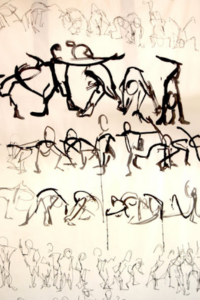
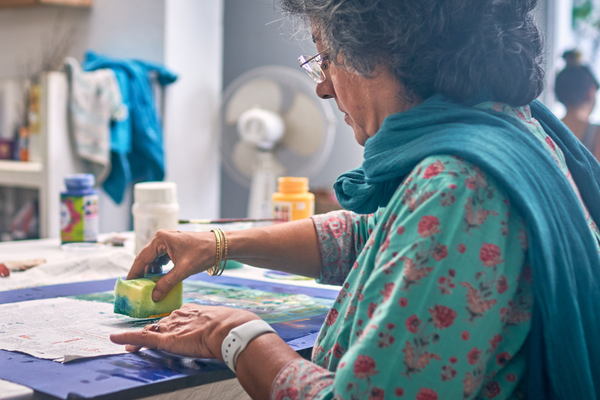
Artistic activities have a key role here because they put the students in a position not only to discover themselves but also to realize that they are able to concretize what they see, to be the creators of themselves and the world.
“Last School gave me the confidence to ask questions—
the kind that actually matter.
It never taught me to hide behind memorized answers.
Instead, it taught me to trust my voice, to express myself clearly, and to hold my own in the world,
whether in a classroom, a workplace,
or just within my relationships.”
~ Alumni, age 22

“No exam is forced, no graduation deadline hangs over your head. You stay until you feel ready — whether that’s four years, five, or more.
The real ask is: What do you genuinely want to do with your time?
Not “What should you do for your future résumé? – Education that acknowledges the person — not the marks.”
~ Age 16
Contents and Methodologies
A new approach requires a conscious evaluation of the tools and materials used in the educational process. Textbooks have subtle orientations that create determinisms and psychological types that perpetuate the social, cultural and national order. Many artificial mental constructions and prejudices, unnecessary determinisms that limit the being, can be avoided if there is alertness in this regard.
In a free progress approach, the artificial pressures which are generated by the need to be successful in certificate and exam systems are removed. It becomes thus most important to awaken a fundamental commitment to the joy of progress. The key is to create a ‘right road’ that leads the students towards their own perfection. It is not only the head but the enthusiasm of the heart that is required. An academic approach does not work. The need is to take into account the psychological nature of the student.
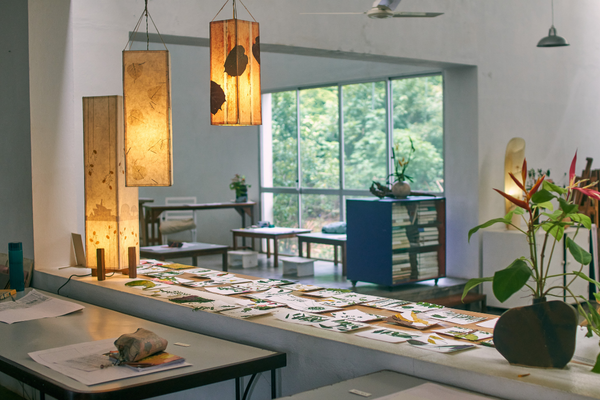
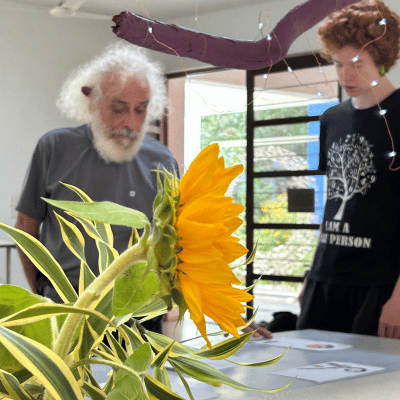
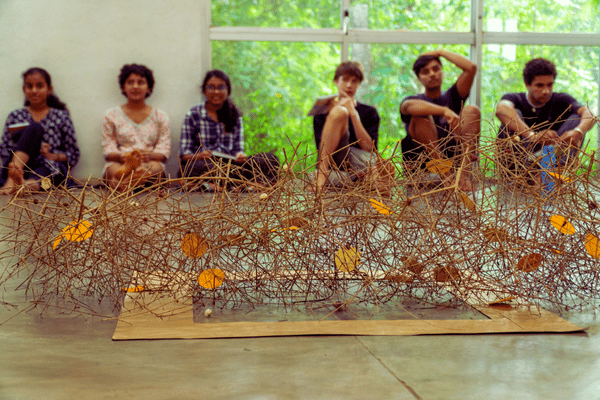
In Last School the relationship between students and teachers is crucial for the learning process. The teachers are asked to be wise friends, guides and helpers not mere pedagogues. And this is particularly illustrated in the intense weeklong workshops that start every semester. The students and teachers become co- learners; companions and comrades in developing skills of one kind or another. These occasions highlight the best method which is personal example, suggestion and influence. They providea period of good company, a satsanga of learning together to fire awake the highest will for progress.
“The Divine manifests in the psychic as love, in the mind as knowledge, in the vital as power and in the physical as beauty.”
~ The Mother
Towards Free Progress